Ways

Descriptions with maps, travel details, distances, physical difficulty of walks and other ways to explorer the great outdoors and have yourself a “Grand Day Out”

Glenariff Mountain and Glens

Maps and photos note: click or tap to see any maps or photographs below as a high resolution version.

Please reuse this map but first see https://www.openstreetmap.org/copyright

Glenariff Waterfalls walks first opened to the public in 1889 as a railway ‘special attraction’ managed by the Northern Counties Railway and accessed by train from Ballymena to Parkmore and then a ride in a jaunting car. The Ess-na-Larach Tea House opened in 1891 and its successor, Laragh Lodge restaurant, still operates on the same site today.

Tourism from Ireland and Great Britain was fundamental to the business of the Northern Counties Railway, and Glenariff Glen, along with the Giant’s Causeway and the Gobbins path, were its core visitor attractions. In the inter-war period over 30,000 visitors a year made the journey here via the Ballymena – Parkmore railway, terminating at the highest train station in Ireland.

I have called this route ‘Glenariff Mountain and Glens’ as much of it runs above the forest tree line at over 800 feet and affords some of the best high walking views to be had in the Glens of Antrim. It also visits both branches of the upper Glenariff, follows the route of the first narrow gauge railway in Ireland (the mineral railway) and ends by climbing past the spectacular waterfalls, which first brought the Victorian visitors here 130 years ago.

Continue reading

Divis and the Black Mountain

Maps and photos note: click or tap to see any maps or photographs below as a high resolution version.

Please reuse this map but first see: https://www.openstreetmap.org/copyright

Belfast is a city surrounded by uplands – the silhouettes of Cave Hill, Divis, The Black Mountain and the Castlereagh and Holywood Hills form its backdrop. Yet these hills for most remain unvisited and unknown. This is partly owing to the usual Northern Ireland problem of general lack of public access, but now, in the case of Divis and the Black Mountain this is no longer a factor. If you haven’t made it there yet this walk should serve as an introduction to this expansive and rewarding area.

The area is owned and maintained by the National Trust who have provided two car parks, a café and a very well designed and maintained series of trails. There is no admission charge so if you can get yourself to the car parks this is a very accessible mountain experience just five miles from the heart of Belfast City.

Continue reading

The Hills of Mount Stewart

Maps and photos note: click or tap to see any maps or photographs below as a high resolution version.

NB It appears to be current policy to close the outer section of this walk (including the fort) over the winter months. Please check that the outer trails are open at reception before starting the walk. Shorter trails are available should this be the case, or you can shorted the route as shown by the purple dashed line below.


Please reuse this map but first see: https://www.openstreetmap.org/copyright

Before first visiting the great mansion and Gardens of of Mount Stewart it would not be unreasonable to imagine it perched on an elevation with magnificent views over Strangford Lough to the distant Mountains of Mourne. In reality the house shelters in a hollow whose benign microclimate supports lush and verdant gardens which completely shield it from the world beyond.

However, the hills are still there and, thanks to the recent acquisition by the National Trust of land covering the whole of the historic demesne, this walk allows you to visit some of them.

Continue reading

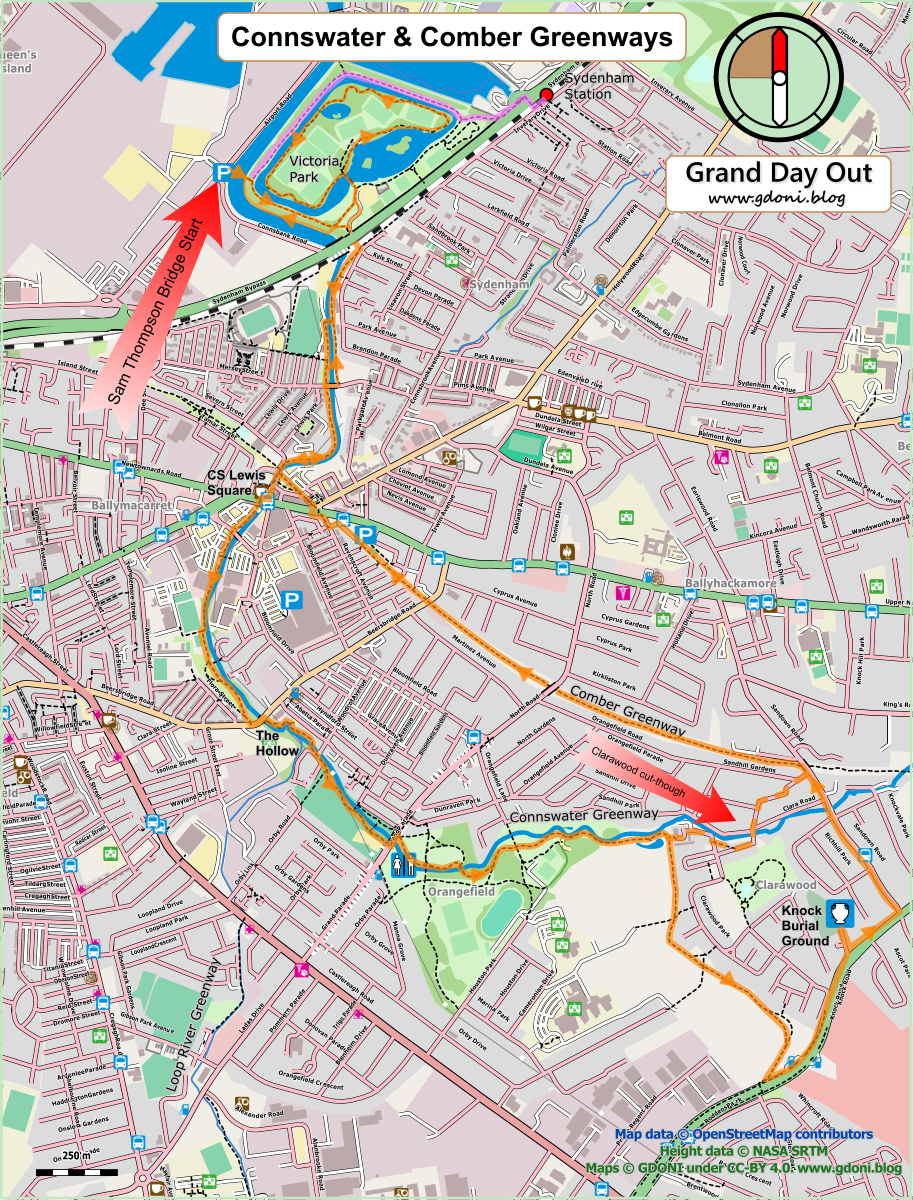
Connswater and Comber Greenways Loop

Maps and photos note: click or tap to see any maps or photographs below as a high resolution version.


Please reuse this map but first see: https://www.openstreetmap.org/copyright

The creation of Greenways as a means of improving urban life has been one of the success stories of the 21st century. By providing local outdoor exercise, access to green space and linking communities separated by traffic, noise and pollution they can deliver community benefit in the long term. East Belfast is fortunate to have two of the best Greenways. The older Comber Greenway along a disused railway line is an efficient pedestrian and cycle route from the heart of the city far into open countryside. The newer Connswater Greenway ingeniously links existing parks via a rescued urban waterway and a great new cultural hub based around the imaginary world of Belfast author C S Lewis. This walk explores both.

Continue reading